
Latest Blogs
View all


Intercompany elimination is conceptually straightforward. When Entity A sells to Entity B within the same group, the revenue in A and the corresponding cost in B must cancel out in consolidated financials. Leave them in and you overstate both revenue and cost. The logic is simple. The execution is not.
The difficulty is matching. Entity A records a transaction in Tripletex. Entity B records the corresponding transaction in Business Central. The two systems have different data models, different account structures, different posting conventions. Nothing in either system automatically identifies these transactions as counterparts. A controller must find them, verify the match, calculate the elimination entry, and post it — every month, across every intercompany relationship in the group.
In a group with ten entities and twenty intercompany relationships, this process can take days. In a group with fifty entities, it is a substantial portion of the month-end close.
AI treats this as a pattern recognition problem.
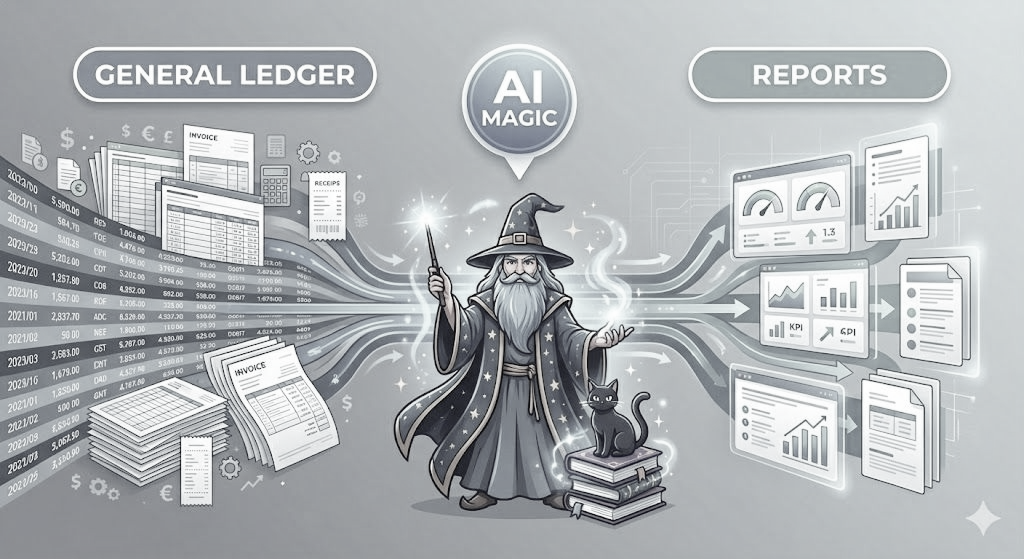
Intercompany transactions follow predictable structures. A sale generates a revenue entry with a specific counterparty and a cost entry on the other side. A loan generates interest income and interest expense. An intercompany payable has a matching receivable. These patterns are detectable — and an AI-native system monitors transaction flows continuously, identifies pairs based on financial logic and counterparty relationships, and packages them for human review.
The controller receives a structured set of proposed eliminations: matched transaction pairs, calculated entries, flagged discrepancies where amounts don't reconcile. Review and approve what is correct. Investigate what is not. No manual hunting through spreadsheets. No building elimination schedules from scratch each month.
The human approval step is non-negotiable. Intercompany eliminations affect consolidated P&L and balance sheet directly. Audit integrity requires human sign-off. The AI handles recognition and preparation; the controller maintains accountability for what posts.
Because the system runs continuously, discrepancies surface as they arise — not when the close cycle begins and it is already too late to investigate cleanly.
Why AI-Native Architecture Is the Only Way to Automate Intercompany Eliminations Across Multiple ERPs