

Latest Blogs
View all






Logistics runs in real time. E-commerce runs in real time. SaaS metrics run in real time.
Group finance still runs in monthly batches. Ten days of assembly every month. Then a board pack describing a world that no longer exists.
This is not a process problem. It is an architecture problem.
This is not unusual. Most multi-entity finance teams I talk to describe the same pattern.
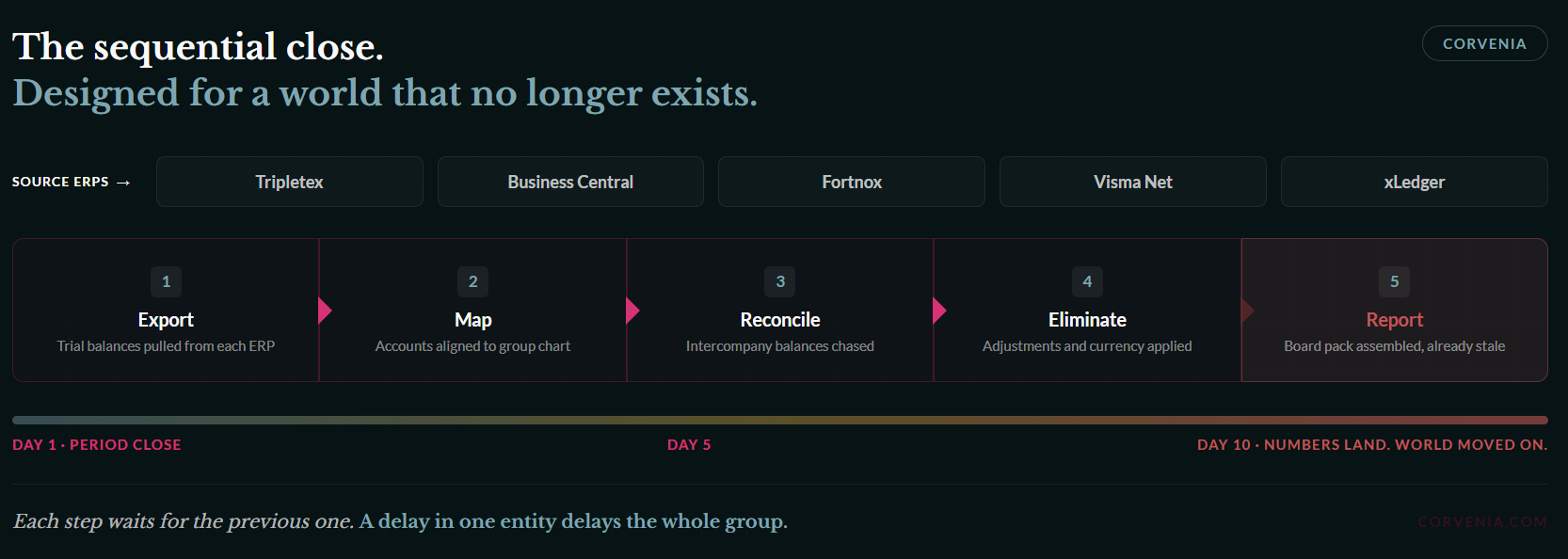
The close process starts with exports. Trial balances pulled from each ERP. Data copied into spreadsheets. Manual checks against intercompany balances. Currency conversions applied by hand or through rigid templates that break when a new entity is added.
Then comes reconciliation. Mapping accounts from different charts into a group view. Identifying discrepancies. Chasing down explanations from entity controllers who are running their own close in parallel.
Then consolidation. Eliminations. Adjustments. A final review that is more about catching errors than generating insight.
The entire process is sequential. Each step waits for the previous one. A delay in one entity delays the whole group.
The reason month-end close looks this way is not that finance teams chose it. It is that the infrastructure assumed it.
Traditional consolidation tools were built for a world where data moves in batches. You export at period end. You import into the consolidation layer. You process. You report.
Every step is a discrete event. The architecture is built around periodic snapshots, not continuous data flow.
When the group was two entities on the same ERP, this worked. The batch cycle was short enough that the delay was acceptable.
At sixteen entities across three ERPs, the batch cycle is the bottleneck. Not because the tools are slow. Because the architecture forces everything into a sequential queue that only runs once a month.
The alternative is not faster batch processing. It is removing the batch entirely.
When ERP data flows continuously into a canonical layer, there is no export step. The data is already there. Account mappings are applied as data arrives, not as a monthly project. Intercompany balances are matched in real time, not reconciled after the fact.
Currency conversion happens at the transaction level with the rate that applied at the time, not as a bulk adjustment at period end.
The “close” becomes a verification step. The controller reviews a consolidated view that already exists and confirms it is correct. Instead of ten days of assembly followed by a review, it is a review from day one.
This is not theoretical. It is how modern data infrastructure works in every other domain. Logistics, e-commerce, SaaS metrics. Finance is one of the last functions still running on a batch cycle designed for a single-entity, single-ERP world.
Most finance teams accept the month-end close as a fixed cost. Ten days is just what it takes.
But the real cost is not just the ten days. It is what arrives at the end of them.
The business runs without current financials. The CFO presents numbers to the board that are already stale. Operating partners at the PE firm get a portfolio view that reflects last month, not this week.
And what finally arrives is the symptom layer. Group EBITDA. Working capital. Cash conversion. Consolidated KPIs that show what changed, not why.
The depth underneath sits inside each ERP. Which entity moved the margin. Which customer segment. Which product line. Which posting. That data exists. The consolidated view does not carry it through.
So the team sees a margin problem six weeks after it started. And when they see it, they still have to go back to each entity and ask why.
Late symptoms. No depth. That is the actual cost.
Speed of financial visibility is not an efficiency metric. It is a strategic capability
We built Corvenia around this principle. The canonical data layer connects to each ERP and normalizes data as it flows, not at period end.
Account mappings are proposed by AI and approved by a controller. Intercompany eliminations are identified automatically. The consolidated view updates continuously.
Qben Infra runs 41 entities across multiple ERPs on this architecture. Their close is not a ten-day assembly exercise. It is a verification step that starts on day one.
The difference is not a better process. It is a different architecture. One that treats financial data as a continuous stream, not a monthly batch.
The firms that move from batch to continuous will not just close faster. They will decide faster. They will see problems earlier. They will operate with a financial picture that reflects today, not last month.

