
Latest Blogs
View all






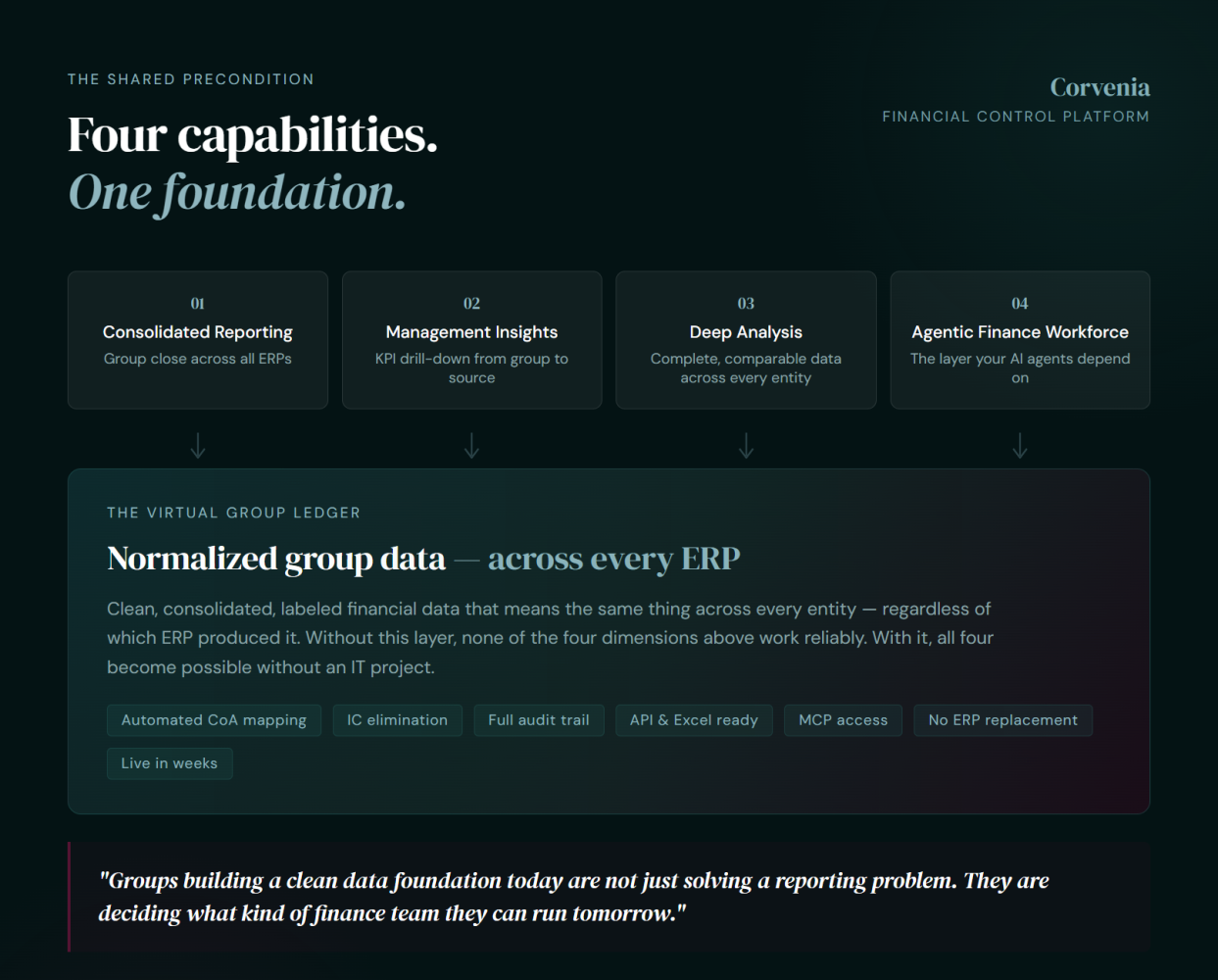
Financial control across a multi-entity group requires four things: consolidated reporting, management insights, deep analysis, and a data foundation ready for the AI agents entering finance functions. Each fails in a different way and for a different reason. Each depends on the same precondition: a single, normalized view of financial data across every entity in the group. Most groups do not have that. Until they do, all four dimensions remain harder than they should be. This article maps what each requires, where most groups get stuck, and what changes when the underlying data problem is solved.
When I talk to CFOs and CEOs running multi-entity groups, the conversation usually starts with one problem but quickly reveals three others. Consolidation is slow. Reporting is late. Nobody can explain the numbers well enough to act on them. And when AI tools enter the picture, the outputs are impressive until someone asks where they came from.
These are not variations of the same problem. They are four distinct dimensions of financial control, each with its own failure mode, each requiring the same foundation to work properly.
Every entity closes its books. The group needs one view. Between those two facts sit multiple ERP systems with different chart of accounts structures, and intercompany transactions that appear as revenue in one entity and a cost in another.
In most groups, a controller or senior finance person spends days — sometimes the better part of two weeks — on this data work every month. The consolidated number eventually arrives, but the window for doing something with it has usually closed.
Consolidated reporting is the most visible dimension, and the only one most consolidation tools genuinely attempt to solve.
Consolidated numbers tell you the outcome. They rarely tell you why.
Most groups can report that EBITDA dropped three points in Q3. Fewer can say which entity drove it, whether it reflects a structural shift or a one-off, or which cost line is responsible. Getting from the group number to that level of understanding typically means opening several spreadsheets and spending time nobody has.
By the time most finance teams have assembled the data to answer "Why did this happen?", the conversation has already moved on.
Management insight at group level means being able to drill from a KPI straight to the entity, the cost centre, and the transaction that produced it. Groups that have this can act on what they see. Groups that do not spend the month assembling the answer rather than responding to it.
Clean actuals also create the foundation for comparing performance against plan and forecast, though that layer only becomes meaningful once the underlying data is reliable enough to compare.
Most groups have a BI tool they like. Power BI, Excel, or something else. The tool is rarely the problem. In a multi-entity setup, the data going into that tool is almost never complete. Each ERP holds a partial picture of the group. Figures are not normalized across entities. What looks like a comparable metric across the portfolio is often different measurements dressed in the same label.
A revenue figure from entity A and a revenue figure from entity B look like the same metric. They are often measuring entirely different things.
Deep analysis requires data that is complete, normalized, and comparable across every entity in the group. When that foundation exists, a CFO can use whichever analytical tool the team already knows and get answers that hold up. Without it, even sophisticated analysis runs on an incomplete picture.
Finance functions will over the next few years gain access to a range of AI agents capable of explaining variances, drafting board commentaries, flagging anomalies before they surface in the numbers, and answering ad hoc questions about group performance. Several already exist in early form and the pace of development is fast.
The difference between an agent that is genuinely useful and one that becomes a liability is straightforward: Can it show where its answer came from? An agent working across raw data from four different ERP systems, each with its own account structure and business logic, will produce confident answers. It will not be able to trace them. In front of a board or an auditor, a number without a traceable source is a number you cannot use.
Groups building a clean, normalized, auditable data foundation today are not just solving a reporting problem. They are deciding what kind of finance team they will be able to run in three years.
Our CTO Imran Tamboli has written about this from the technical side: what it takes for an AI agent to reason reliably across multi-entity financial data. The short version is that the agent is not the bottleneck. The data layer underneath it is.
All four dimensions fail for the same underlying reason: the data foundation was never built. Not because the ambition was absent, but because the available solutions required IT projects most groups could not absorb. Months of implementation, ongoing maintenance, a new project every time the structure changed. Many initiatives started and stalled before delivering what was needed.
The groups that move from reactive to proactive financial control will do it by solving the data foundation problem once, then building the four dimensions on top of it.
We built Corvenia because we kept running into exactly this gap. Corvenia connects to the ERPs a group already runs, normalizes and consolidates the data in a Virtual Group Ledger, and makes it available for reporting, analysis, and AI use. Groups are live in days, with no ERP migration and no replacement of existing systems.
If you are managing a multi-entity group and recognize any of these four dimensions as a problem, I would like to show you how we have solved them. Book 30 minutes at corvenia.com/evaluation →