
Latest Blogs
View all






Many Group CFO's I talk to wants the same thing. They want to walk into a board meeting and answer three questions. What is happening across the portfolio? Why? What we are doing about it?
The problem is they spend most of their time understanding what is happening. Collecting data, reconciling it, chasing the numbers into shape. By the time the report is ready, the moment for understanding why and what to do about it has passed.
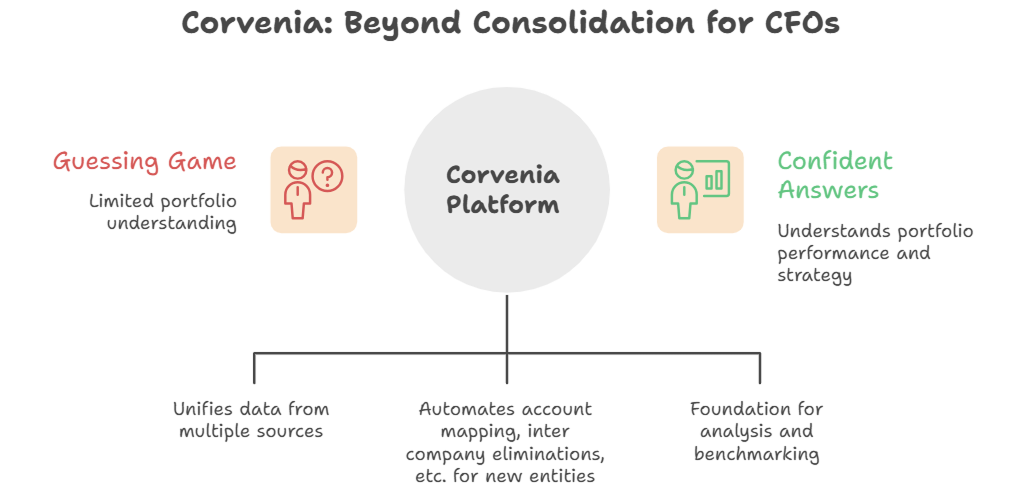
This is the trap that most financial platforms do not talk about honestly. They solve consolidation of aggregated accounting data and call it a win. The CFO gets a dashboard. The numbers close faster. Everyone celebrates.
Six months later, the Group CFO is still guessing. They have better-looking spreadsheets, but not the full-depth, consolidated data sets that would let them understand the reasons behind the numbers. They can see that margins dropped. They cannot explain why.
I have been building software for financial services for 20 years. Before Corvenia, I spent eight years at Simplifai building AI automation for insurance and banking companies. My co-founders came through the same journey. We have all watched a lot of transformation projects that transformed nothing.
A company buys a consolidation tool to fix the reporting problem. The tool does what it promises. Numbers consolidate. Reports go out on time. Then the hard questions start.
"Why did margins drop 4 points in Q3 in this entity?"
"How are our construction companies performing compared to similar-sized groups in Norway?"
"Which of our six acquisitions last year is tracking toward the value creation plan we underwrote?"
The consolidation tool has no answer. It never did. It was built for accountants closing the books. Not for deal teams running a portfolio
When we started building Corvenia we knew consolidation had to come first. You cannot analyze what you have not unified. You cannot benchmark what you cannot measure.
The architecture we built, a real-time virtual ledger that reads from accounting systems simultaneously - was never just about faster closing. When a new entity is acquired, AI maps its chart of accounts to the group structure automatically and inter company transactions eliminated. Hours, not months. No ERP migration. No implementation project. And the foundation it creates is not just for consolidation. It is a live data layer that everything above it can actually use.
That next layer is where the real work happens:
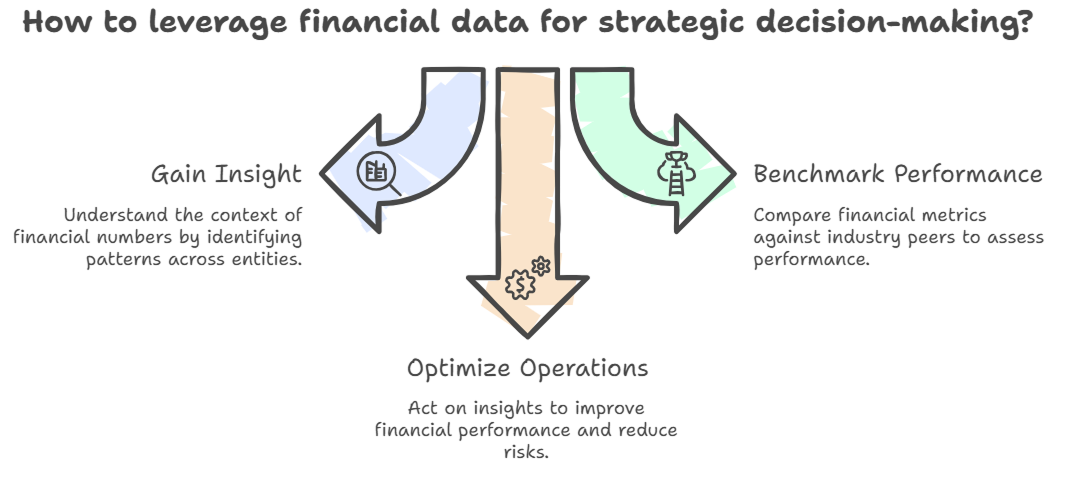
Understanding what the numbers mean in context. Not just "revenue is up 12%" but "revenue is up 12% because of one entity, and the other four are flat or declining." AI-assisted analysis that surfaces patterns across a group that no one would catch reviewing entity-level reports in isolation.
Knowing whether 12% is good. Not against your own history, which may be a low bar, but against comparable companies. Groups of similar size, same industries, same acquisition stage. The first time a PE firm can tell a portfolio company CFO: you are in the bottom quartile on working capital for construction groups your size in the Nordics. Here is what the top quartile looks like.
Acting on what you know. Flagging intercompany transactions creating tax exposure. Identifying entities with excess liquidity that could be redeployed. Surfacing the cost structure decisions that actually move EBITDA.
These are not three separate products. They are one platform. The power is in the connection between them.
And that is before we connect financial data to what is actually happening in the business. CRM pipeline, project margins, headcount costs, contract exposure. The question every PE firm is really asking is not how to read the numbers better. It is how to make the company worth more at exit. That answer lives at the intersection of financial and operational data. More on that soon.
The financial software market is full of platforms that describe themselves in similar terms. Insights. Analytics. AI-powered decisions.
Most of them are consolidation tools with a business intelligence layer bolted on top. Built for CFOs at operating companies who need to close the books. Not for deal teams running portfolios who need to understand what is happening across six acquisitions simultaneously. The AI was added after the architecture was built, which means it is working with exported data, not live data. Batch processing, not real-time. Aggregated summaries, not transaction-level patterns.
The difference matters. When a PE firm acquires its fifth construction company and wants to understand how it compares to the other four, they need that analysis today, not at month-end close. When a group CFO spots an anomaly in the intercompany eliminations, they need to trace it to the source transaction, not a rolled-up journal entry.
Architecture is a strategic decision. The companies that built consolidation first and tried to add intelligence later are constrained by choices they made years ago. That is not a criticism. It is just how software evolution works.
We had the advantage of building after the problem was fully understood.
We are a small team. We are not going to claim we have built all of this fully yet.
Consolidation is live. Real customers are running on it. Qben Infra is consolidating 40+ entities across multiple ERPs in real time. That is not a demo. That is production.
Insight is in active development (coming in beta soon). The patterns we are seeing in multi-entity data are exactly what the architecture was designed to surface.
Benchmark and Optimize are on the roadmap, and deliberately so. The data we are collecting from Consolidation customers will make those modules genuinely useful rather than generically pretty.
This is the sequence that matters. Build the foundation right. Then build on top of it.
The CFOs I respect most are already thinking past the close. They know that faster reporting is table stakes now. What they are actually trying to solve is the question that comes after the numbers land. "What should we do about this?"
That is the platform we are building.
If you are running a multi-entity group and still spending more time building the report than reading it, I would like to show you where the real work starts.

