

Latest Blogs
View all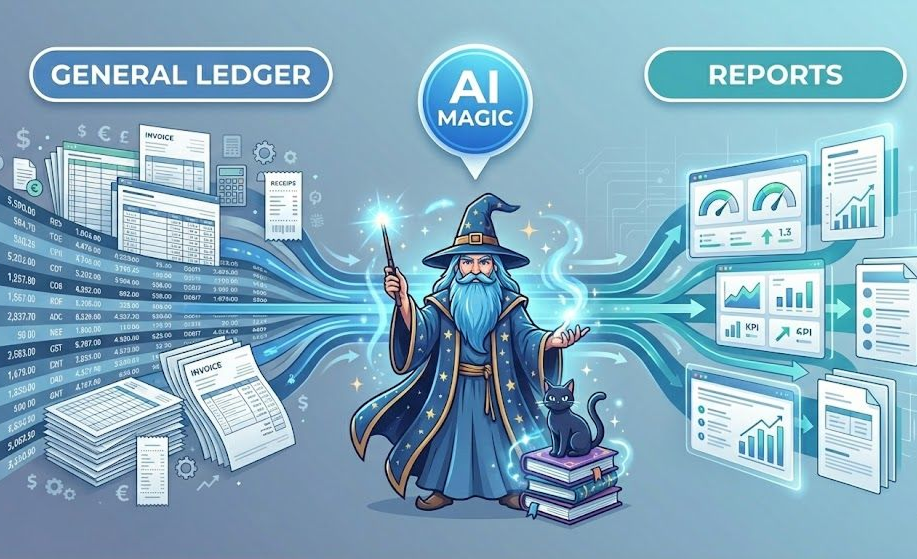






The most common reason consolidation projects stall is that they require something no one budgeted for: getting every subsidiary onto a compatible ERP. One entity runs Tripletex. Another runs Visma Net. A third was acquired six months ago and still runs whatever the previous owners used. Standardising all of that is a multi-year project — if it happens at all.
An independent data layer reads each ERP in its native format. There's no migration, no forced upgrade, no parallel running period. The group gets consolidated financials from day one. The subsidiaries carry on as normal.
Most finance teams have spent years building their reporting in Excel. Some have moved parts of it into Power BI. Either way, they're not looking to learn a new interface — they're looking for better numbers to feed into the one they already use.
A data layer doesn't replace those tools. It connects to them. The consolidated view surfaces wherever your team works: Excel, Power BI, or via API for anything custom-built. No retraining, no resistance, no six-week onboarding program.
Traditional consolidation runs in batches. You close the month, export the files, run the process, and get a report that's already out of date by the time anyone reads it. By then, whatever the numbers were telling you has moved on.
An independent data layer ingests continuously. Transactions post in a subsidiary and the group view updates. That means problems show up early — a cash position drifting, a margin compressing, an intercompany balance that doesn't net — while there's still time to act. Reporting that arrives after the fact is interesting. Reporting that arrives in time is useful.
Vendor lock-in in financial software is quieter than people expect. Your data is technically exportable — but in formats designed for reimport into the same system. Your team learns to think in the vendor's taxonomy. Your reports get built around the vendor's data model. Switching becomes expensive not because of contracts, but because of dependency.
Vendors who build around a proprietary interface can't offer open APIs without cannibalising their own retention model. It's not a policy choice — it's a structural constraint. An independent data layer is built the other way around: the data is accessible in open formats from day one. Excel today, Power BI tomorrow, a new tool next year. The reporting surface can change without touching the layer beneath it.
Groups aren't static. Subsidiaries get added. Entities restructure. A new acquisition comes in with a different chart of accounts and a different ERP. With a traditional consolidation system, each of these events is a project: new mappings, new configurations, someone from IT involved, a timeline measured in weeks.
An independent data layer is built to handle this. AI suggests the account mappings for a new entity; a controller reviews and approves them. The structure updates. The group view expands. No implementation project, no disruption to reporting in the meantime. The platform adapts because the architecture expects change — not because someone patches it each time.
Hours — Time to first consolidated view, not months
95% — Reported time savings on consolidation cycles

